Conservation
Vulnerable globally, thriving here.
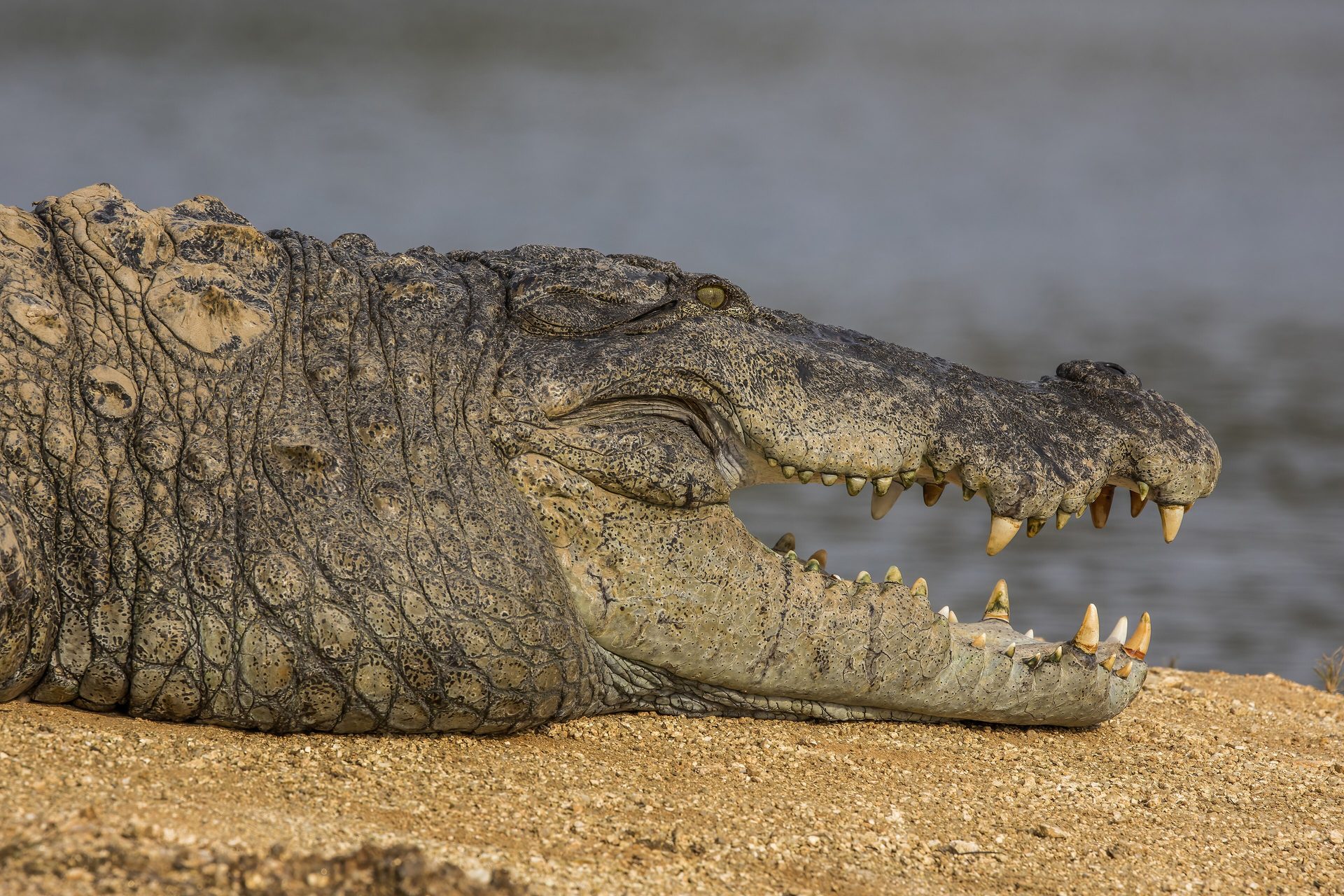
Vadodara's stretch of the Vishwamitri quietly runs one of the healthiest urban populations of a globally Vulnerable species anywhere on Earth. That's not an accident — it's the result of legal protection, habitat that's mostly been left alone, and a city that learned to share a riverbank.
IUCN Red List
Vulnerable
The mugger (Crocodylus palustris) is assessed as Vulnerable on the IUCN Red List — declining across much of its range even where local populations, like Vadodara's, are stable or growing.
Wildlife Protection Act, 1972 (India)
Schedule I
India's highest tier of legal wildlife protection — the same schedule as the tiger. Hunting, capturing, or harming a mugger, or trading its parts, is a serious criminal offence.
What Vadodara gets right
A dense urban population, by design and by luck.
Local surveys and reporting describe the urban Vishwamitri as supporting hundreds of wild muggers — among the densest urban crocodile populations anywhere in India. That density exists because the basics stayed intact: a river that still floods and recedes naturally, banks that weren't all concreted over, and a population of neighbours who, for six hundred years, chose distance over conflict rather than removal.
Legal protection sets the floor — Schedule I status makes harming a mugger a serious offence, full stop. But law alone doesn't explain a healthy population in the middle of a growing city. That takes habitat that still works: ponds and vegetated banks that haven't been filled in, muddy edges left soft enough to bask on, and nesting ground that isn't cleared every season. Everything the Habitats chapter describes as a threat — landfilling, hard concrete edges, vegetation removal, pollution — is also, in reverse, a conservation checklist.
What actually puts this at risk
The pressures on an urban river.
Habitat loss
Pond filling, bank hardening, and vegetation clearing remove the basking, nesting, and nursery space a mugger population actually depends on.
Pollution
Sewage and industrial discharge degrade water quality and the prey base the river's crocodiles rely on — an urban river carries urban risk.
Unsafe encounters
Crowding, feeding, or provoking a wandering or basking crocodile puts both the animal and the person at risk, and undoes decades of calm coexistence in a moment.
The riverbank code
How a city keeps the peace.
Six hundred years of coexistence runs on unwritten rules. Here they are, written down.
- Keep a respectful 10 metres from any basking mugger — it was here first.
- Call the forest department helpline when a croc wanders; never a crowd.
- Let rescue teams work — a covered eye and a quiet street is all they need.
- Treat the river as a home, not a backdrop — every reed bed is a nursery.
- Teach the kids what a makara is before teaching them what a monster is.
- Feed the muggers. A fed croc learns the worst possible lesson about people.
- Swim or wade the Vishwamitri — the river's residents value their privacy.
- Crowd, poke, or selfie a stranded crocodile. It is having a bad enough day.
- Dump waste in the river that both species have to drink from.
- Panic. In 600 years, calm has worked every single time.
Field sources
Where the numbers come from.
Mugger City is a storytelling field guide, not a scientific paper. The figures here are approximate and drawn from the kinds of public sources below — we round gently and say "hundreds" rather than pretend to a precise census.
Conservation status
The mugger (Crocodylus palustris) is listed as Vulnerable on the IUCN Red List, and as Schedule I under India's Wildlife Protection Act, 1972.
Rescue & monsoon reports
Flood-season crocodile rescues around the Vishwamitri are carried out by the Gujarat Forest Department and local volunteers, and widely documented in regional reporting.
Population estimates
Local surveys and reporting describe the urban Vishwamitri as supporting hundreds of wild muggers — among the densest urban crocodile populations in India.
Named individuals
Individual crocodiles referenced elsewhere on this site are representative composites for storytelling, inspired by real scute-and-scar identification methods — not records of specific animals.
Photographs
Imagery is from Wikimedia Commons and reused under its licences. Vadodara street and market photographs by Snehrashmi and Jeyaselvand (CC BY-SA 4.0); the Vishwamitri by Lashushwet (CC BY-SA 4.0); mugger portraits by Charles J. Sharp (CC BY-SA 4.0), Bernard Gagnon (CC BY-SA 3.0) and Giles Laurent (CC BY-SA 4.0). The Baroda street scene of c. 1880 is public domain.
Figures are rounded and illustrative. Where a precise, verified source isn't available, we soften the claim rather than overstate it.
Read next
Know the Mugger →
Eight chapters on the biology, behaviour, and history of Crocodylus palustris.