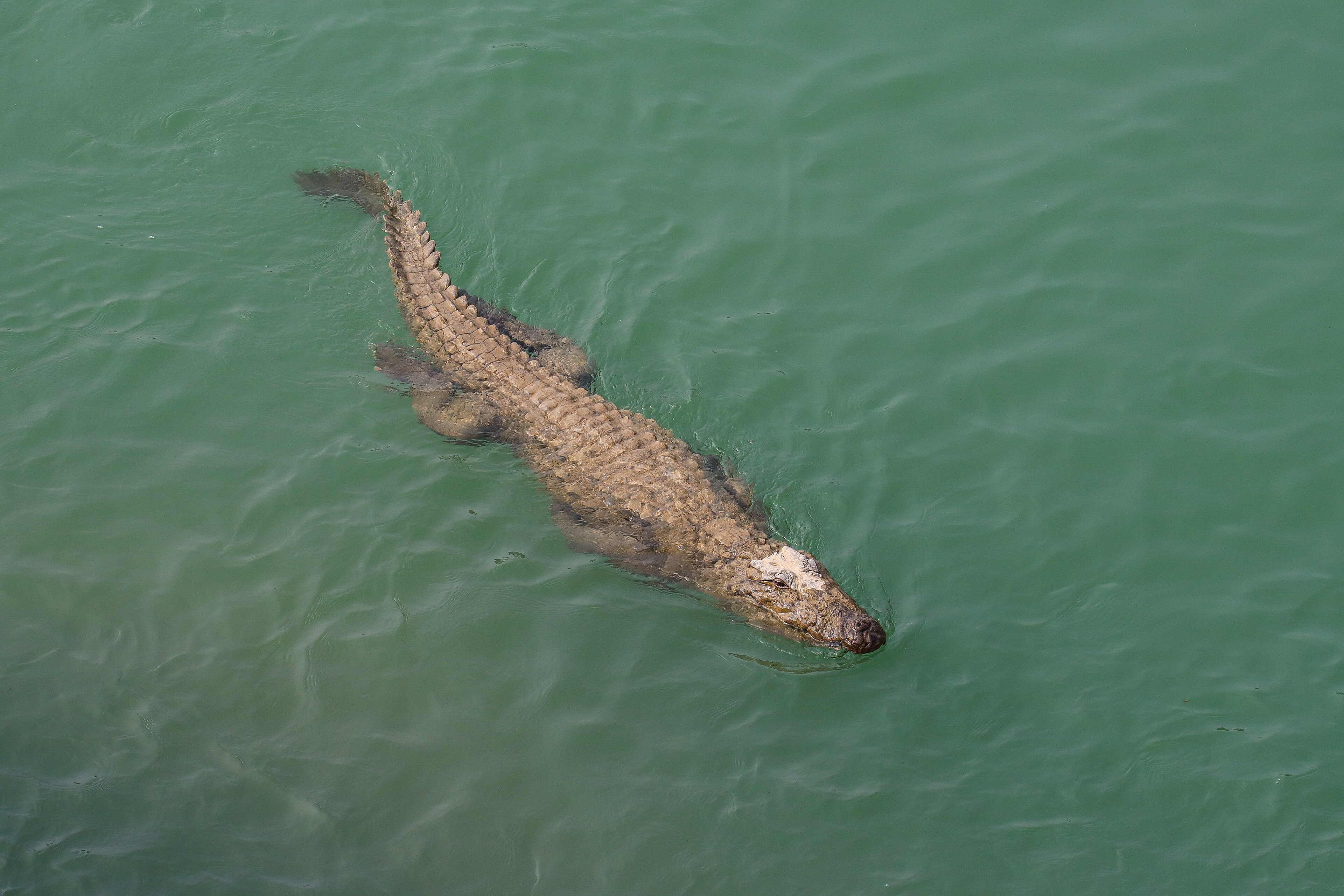
Know the Mugger — a living encyclopedia
Everything a good neighbour should know.
Crocodylus palustris — the marsh crocodile, the makara of myth, and the longest-standing resident of the Vishwamitri. Two parts to explore: three hands-on galleries you turn, toggle and rotate by hand — then four short chapters to read at the water's edge.
Part One · The Exhibits
Three galleries, hands-on
Pick a gallery. Each one opens in full.
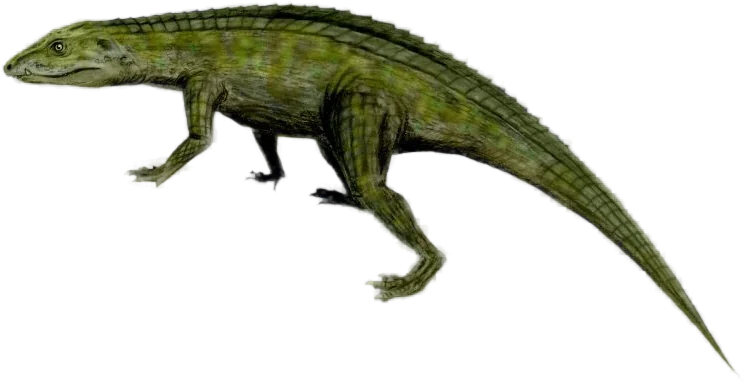
Gallery 01 · Evolution
Evolution Timeline
230 million years down the crocodilian family tree.
Enter the timeline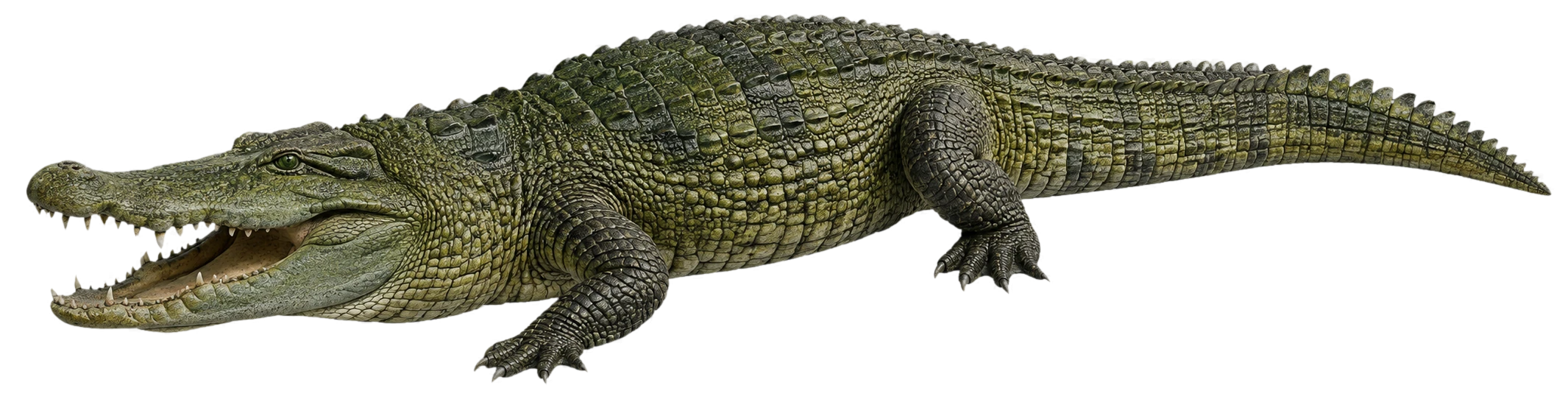
Gallery 02 · Anatomy
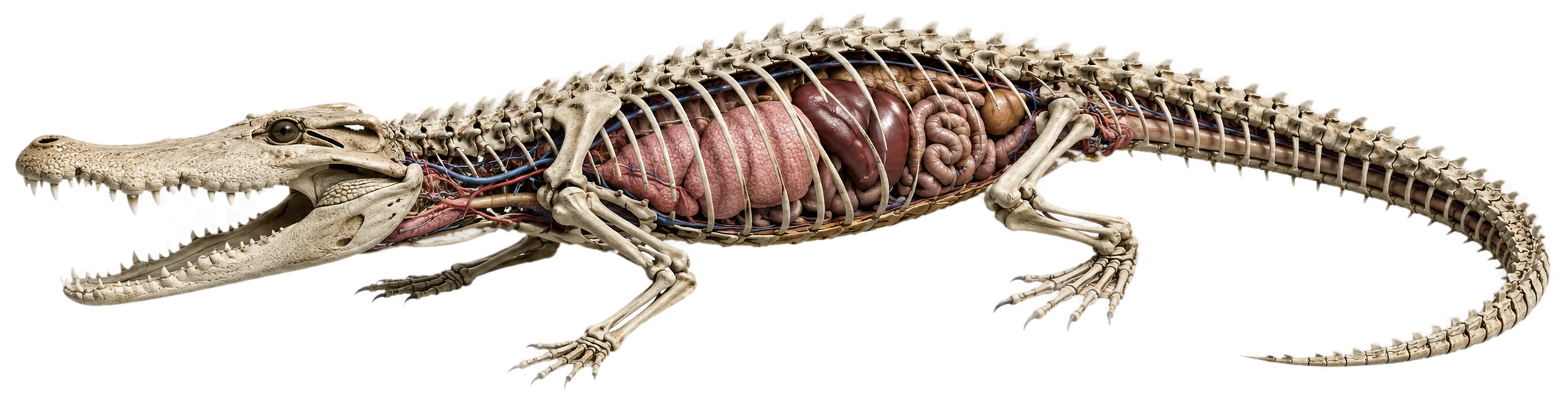
Anatomy X-Ray
One specimen, two states — outside, then beneath the skin.
Open the specimen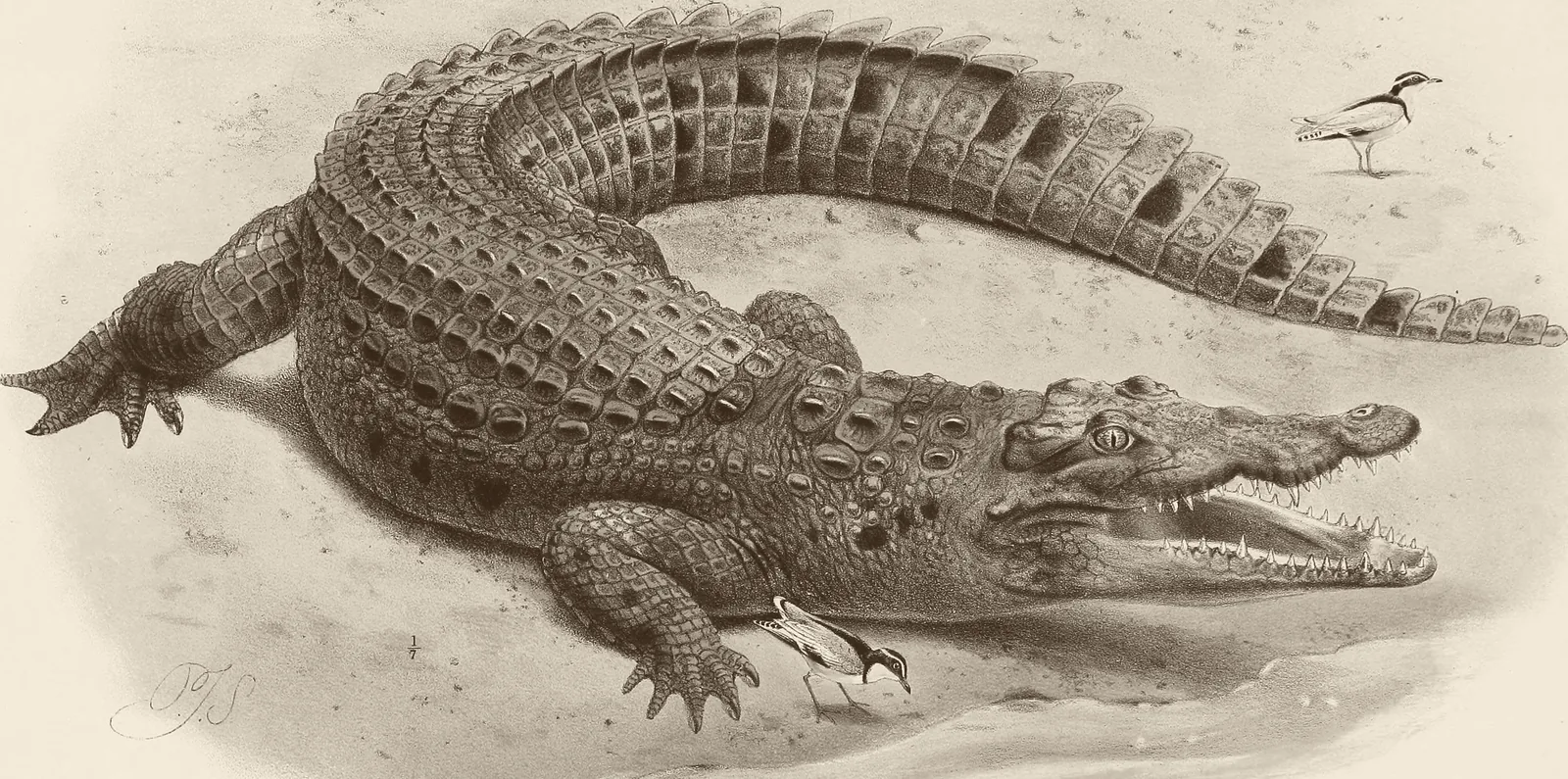
Gallery 03 · Life Cycle
Life Cycle
Eight stages. One continuous journey of survival.
Enter the cyclePart Two · The Reading Room
Four chapters to read
From how a cold-blooded body borrows its warmth to the facts worth carrying to the riverbank — read straight through, or use the index on the left to jump.
Cold blood, warm river
A mugger crocodile has no internal thermostat. Every degree of its body temperature is borrowed from the world around it — and won by behaviour, not metabolism.
Crocodiles are ectotherms: they don't burn food to generate body heat the way a bird or mammal does. Instead their temperature drifts with their surroundings, and they spend much of the day actively chasing the right one — shuttling between sun and shade, bank and water, to hold their body somewhere they can actually function.
A quieter kind of heat
The temperature that decides a hatchling's sex
A mugger doesn't just feel temperature — its nest is shaped by it, months before anyone knows the eggs exist. Like most crocodilians, the mugger has no sex chromosomes. Instead, the temperature inside the nest during a critical window of incubation switches development toward male or female.
Cooler nest
→ Female
Nests in shaded or well-vegetated banks run cooler and skew female — vegetation cover measurably steadies nest temperature.
Mid-range nest
→ Male
A band of intermediate temperatures — roughly a couple of degrees wide, wider than in many other crocodilians — produces males.
Hotter nest
→ Female
Push past that middle band and development swings back to female — a female–male–female pattern documented in mugger crocodile studies.
A city with two temperatures
Vadodara's year gives the mugger two very different thermal problems: a long, punishing dry-season heat that pushes it toward water and shade rather than the open bank, and a monsoon that cools the air but floods the very banks it needs for basking and nesting. Its behaviour — where it baskets, when it gapes, which bank it nests on — is a running negotiation with a climate that never holds still.
Climate chapter · Mugger City — thermoregulation and temperature-dependent sex determination described here follow published crocodilian field studies; exact figures vary by population and are presented as general patterns, not site-specific measurements.
Waste, the reptile way
A mugger crocodile has no bladder and no urine stream. What leaves its body is built around one problem every reptile shares: getting rid of nitrogen without wasting the water that's actually hard to find.
Every animal that breaks down protein has to dispose of nitrogen, and the form it takes says a lot about the animal's relationship with water. Desert lizards, which can't afford to lose a drop, excrete nitrogen almost entirely as a dry uric-acid paste. A mugger lives inside a river — so its kidneys took a different, more relaxed route.
Not quite what the textbooks say
Three ways to get rid of nitrogen
Most reptiles are described as "uricotelic" — excreting nitrogen almost entirely as uric acid to save water. Crocodilians bend that rule. Living in and around water most of the time, a mugger can afford to flush a large share of its nitrogen as dilute ammonia and urea in liquid urine, alongside a whitish uric-acid paste. Roughly, its excreted nitrogen splits out like this:
An inherited toolkit
Salt glands it rarely needs
True crocodiles — the genus Crocodylus, which includes the mugger — carry a pair of lingual salt glands on the tongue, able to pump out excess sodium and chloride directly. Alligators and caimans, a separate crocodilian lineage, simply don't have them.
The mugger is one of the more freshwater-committed members of that family, spending most of its life in rivers, ponds, and reservoirs rather than tidal creeks. Its salt glands mostly sit idle. But the mugger is also known to turn up in brackish water on occasion — and when it does, it's carrying equipment built for a saltier life its ancestors led.
A freshwater life, run on a saltwater blueprint
The Vishwamitri gives the mugger almost none of the salt stress its estuarine cousins live with — which is exactly why its excretory system reads like a compromise. Ready access to river water lets it excrete nitrogen the "expensive" way, in liquid urine, rather than relying solely on the water-tight uric-acid route that desert reptiles are forced into. It's a freshwater animal quietly carrying spare parts built for a different life.
Excretory System chapter · Mugger City — nitrogen-excretion proportions and salt-gland distribution follow published crocodilian physiology studies and are presented as general species-level patterns, not measurements from a specific population.
Rumour control
Myth, meet fact.
Vadodara's muggers have lived beside millions of people for centuries with vanishingly few incidents. Humans aren't on the menu — fish are. Respectful distance keeps it that way.
Crocs really do "cry" while eating — air forced through the sinuses pushes tears out. It's plumbing, not performance. The idiom got the biology backwards.
A mugger explodes from stillness to strike in a fraction of a second and sprints at 12 km/h on land. The stillness isn't laziness — it's the oldest ambush strategy on Earth.
Relocated muggers famously walk home — sometimes dozens of kilometres. And the species is Vulnerable globally; Vadodara's population is a conservation asset, not a problem to ship away.
Feeding teaches crocodiles to associate humans with food — the one lesson that genuinely breaks the truce. The kindest thing you can hand a mugger is distance.
Carry these
12 facts about the mugger.
№ 01
Older than the dinosaurs' end
Crocodilians survived the asteroid that ended the dinosaurs. The shape you see in the Vishwamitri is 200 million years of "no notes."
№ 02
Mugger means makara
The name is Sanskrit, not slang — makara, the mythic water beast, became magar in Hindi, then "mugger" in colonial English.
№ 03
The gape is a thermostat
An open-mouthed croc isn't threatening you. It's cooling off. Muggers can't sweat, so they park with jaws wide like a car with open doors.
№ 04
They walk to work
Muggers are champion overland walkers among crocodilians — kilometres in a night on surprisingly brisk legs. Hence the monsoon surprises.
№ 05
Tool users — maybe
Muggers have been observed balancing sticks on their snouts during heron nesting season — possibly bait. Possibly genius. Researchers argue.
№ 06
The nest decides the sex
No chromosomes involved — incubation temperature determines whether hatchlings are male or female. Warm centre, cool edges, mixed family.
№ 07
A devoted mother
She guards the nest for two months, digs the hatchlings out when they squeak, and carries them to water in those same crushing jaws — gently.
№ 08
Teeth on subscription
Each of the 66 teeth is replaced again and again — a mugger may run through 3,000 teeth in a lifetime. Dentists weep.
№ 09
Stones for ballast
Muggers swallow stones — gastroliths — that grind food and trim their buoyancy like a submarine's trim tanks.
№ 10
An hour underwater
Resting heart rate drops to a few beats per minute. The river you glance at holds more watchers than it ever shows.
№ 11
City crocs eat modestly
Fish, water birds, the odd unlucky dog. A big mugger can fast for months — the "man-eater" reputation belongs to other species elsewhere.
№ 12
Vadodara is a stronghold
Globally Vulnerable, locally thriving. This unbothered city quietly runs one of the most successful mugger habitats in the species' range.
Habitats of the Mugger
From ponds and muddy banks to the urban Vishwamitri, discover the living spaces that shape Baroda's crocodiles.
A crocodile habitat is not just water. It is a living system of banks, vegetation, mud, warmth, nesting soil, prey, shade, and movement routes. In Baroda, that system runs through the city itself, shaped by the Vishwamitri River and its connected ponds, banks, bridges, and wetlands.
Habitat plates · field photographs, tinted for the exhibit, Mugger City · hover any plate to look beneath the surface
The Vishwamitri story is not only about crocodiles surviving in water. It is about an entire urban river edge where wildlife, city growth, pollution, vegetation, and human coexistence all meet. Protecting the mugger means protecting the whole river habitat around it.